
Quick and Easy Croissants from Scratch

, Updated Nov 09, 2026
This post may contain affiliate links. Please read our disclosure policy.
This easy croissant recipe uses a quick-method dough – no butter block and no fiddly laminating – so you can make flaky, buttery homemade croissants from scratch with about 30 minutes of hands-on work. The dough itself takes 20 minutes. The rest is chilling and rising while you get on with your day.
You will also love my Almond Croissants

Table of Contents
- Why You’ll Love This Recipe
- The Story Behind the Quick-Method Dough
- How Long Do Croissants Take to Make?
- Here’s What You’ll Need
- How to Make Croissants from Scratch
- Equipment
- Make Ahead, Storage and Freezing
- Ways to Use Your Croissants
- Frequently Asked Questions
- Quick and easy croissants from scratch Recipe
- Troubleshooting Croissants
- More Pastry Recipes to Try
Why You’ll Love This Recipe
- No butter block: cold butter is pulsed straight into the flour, then rolled and folded – the layers build as you go.
- Beginner friendly: if you can make pie dough (shortcrust pastry), you can make these.
- Flexible timing: bake them the same day or chill the dough overnight for fresh croissants at breakfast.
- Just seven ingredients: flour, butter, milk, sugar, yeast, salt and an egg yolk to glaze.
The Story Behind the Quick-Method Dough
Croissants sat at the top of my to-bake list for years, but the thought of a three-day butter block always put me off. Then I came across Edd Kimber’s 20-minute croissant dough (Edd won the very first Great British Bake Off) and I had no more excuses.
Edd was inspired by the quick Danish pastry dough made famous by Julia Child – actually a recipe by Beatrice Ojakangas, who shared it with Julia on Baking with Julia. It is a rough puff method: the butter goes into the dough in chunks rather than as one slab, and rolling and folding flattens those chunks into thin sheets. I use the same dough for my Quick and Easy Danish Pastries.
I first made these croissants on New Year’s Day 2014, tweaked the method over three batches in a week, and have made them countless times since. They are not quite as airy inside as bakery croissants made the classic way, but they are crisp, flaky and buttery – and every batch disappears almost instantly.

How Long Do Croissants Take to Make?
The recipe card says about 15 hours in total, which puts some readers off – but almost all of that is waiting. Your hands-on time is around 30 minutes, and you can bake the same day if you start in the morning.
| Stage | Time | What is happening |
|---|---|---|
| Mix the dough | 20 minutes | Hands-on |
| First chill | 30 minutes | Freezer (or 2 hours in the fridge) |
| Roll and fold | 10 minutes | Hands-on |
| Long chill | 4 hours to overnight | Fridge – overnight gives the best flavor and layers |
| Shape | 10 minutes | Hands-on |
| Rise | 2–3 hours | Room temperature |
| Bake | 18–20 minutes | Oven |
Same-day plan: mix at 8am, roll and fold by 9am, chill until 1pm, shape, rise, and bake around 4pm. Overnight plan: make the dough the evening before, then shape first thing and bake for a late breakfast or brunch.
Here’s What You’ll Need
↓ For the full ingredients and detailed method, jump to the recipe card.
- Bread flour (strong white flour): the higher protein gives the dough the strength to hold its layers. All-purpose flour (plain flour) works but the croissants will be softer. One reader used whole wheat flour and found they needed 5–6 minutes less in the oven.
- Cold unsalted butter: it must be fridge-cold and cubed. European-style butter with 82% or more butterfat contains less water, so it leaks less and tastes richer.
- Milk: whole milk, warmed to 100–105°F (38–40°C) to wake up the yeast, then cooled completely before it meets the butter.
- Yeast: one packet (2¼ tsp / 7g) of active dry yeast. Instant yeast works too.
- Egg wash: an egg yolk beaten with milk gives a deep golden shine. For an egg-free glaze, brush with a little milk or cream diluted with milk.
How to Make Croissants from Scratch
Make the Dough
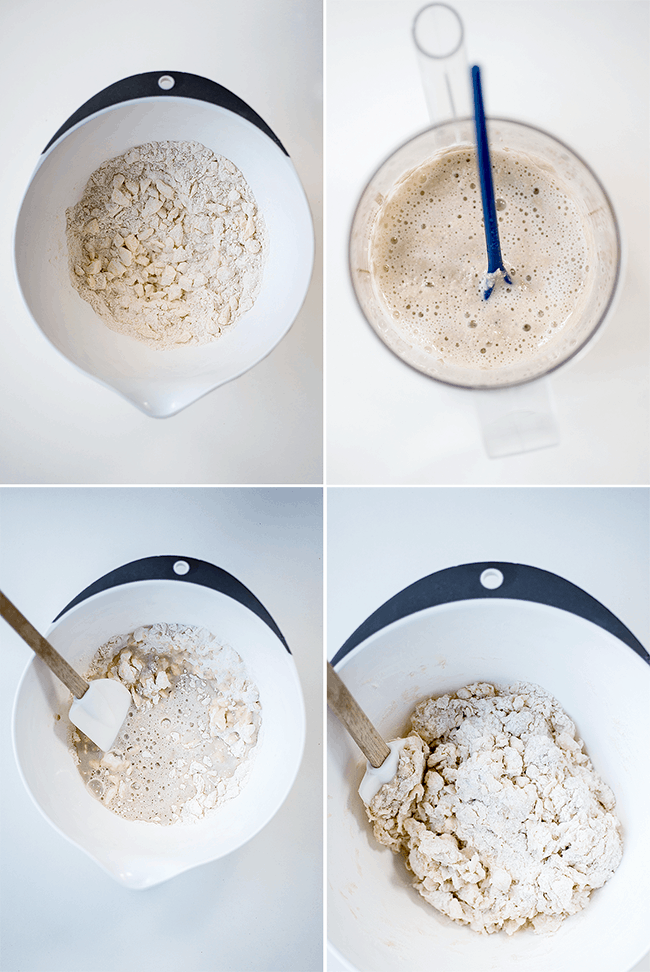
Warm the milk to 100–105°F (38–40°C) – it should feel just warm on your wrist. Whisk in the sugar and yeast and leave for 5–10 minutes until frothy, then let it cool to room temperature. If it is still warm it will melt the butter and undo all your good work.
Pulse the flour and salt in a food processor, add the cold cubed butter and pulse 4–6 times, until the butter is in pea- to hazelnut-sized pieces. Tip into a large bowl, pour in the yeast mixture and gently mix with a spoon or bench scraper until the dough just comes together. Visible chunks of butter are exactly what you want.
Turn the dough out onto a lightly floured worktop, press it into a square, wrap it and freeze for 30 minutes (or chill in the fridge for 2 hours).
Roll and Fold
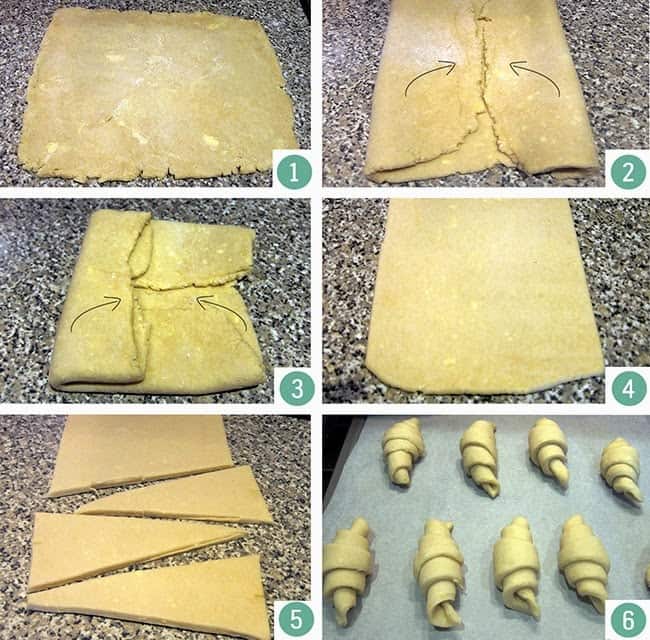
Lightly flour your worktop and rolling pin. Roll the dough into a rectangle roughly three times as long as it is wide (pic 1). It will look brittle and shaggy at first – it comes together as you roll and fold.
Fold the short sides into the middle (pic 2), give the dough a quarter turn, roll it out slightly to lengthen, and fold the short ends to the middle again (pic 3). Flip it over so the seams are underneath and repeat the rolling and folding three more times. The dough becomes smoother and more elastic with every turn.
Shape the dough into a neat rectangle, wrap it well and chill for at least 4 hours, or ideally overnight.
Baker’s tip
Keep the butter cold
If the dough starts to feel soft or sticky, or butter smears through the surface, wrap it and pop it in the freezer for 10–15 minutes before carrying on. Cold butter makes layers; soft butter just makes bread. This is also why the method works well if you have warm hands or a warm kitchen – you can pause whenever you need to.
How to Roll a Croissant
Roll the chilled dough into a long rectangle about ⅛ inch (4mm) thick and trim the edges with a bench scraper (pic 4). Cut it into tall triangles about 12 inches (30cm) long with a 3-inch (8cm) base, then cut a small slit in the center of each base (pic 5). Offcuts can be stacked, rolled out again and used.
Gently stretch each triangle by the corners and tip, then roll it up loosely from the base toward the point. Place them tip-side down on a baking sheet lined with parchment paper (baking paper), a few inches apart (pic 6). Tucking the tip underneath stops them unrolling in the oven.
Let Them Rise and Bake
Cover loosely with greased plastic wrap (cling film) and leave at room temperature – ideally 68–72°F (20–22°C) – for 2–3 hours. There is no shortcut here, and do not put them somewhere warm: above 75°F (24°C) the butter melts out of the layers.
Baker’s tip
The jiggle test
The croissants are ready to bake when they have roughly doubled in size, look puffy, and wobble when you gently shake the tray. You should be able to see the layers on the sides.
Heat the oven to 450°F (230°C, 210°C fan). Brush the croissants gently with egg wash using a pastry brush and bake for 10 minutes, then lower the heat to 375°F (190°C, 170°C fan) and bake for 8–10 minutes more, until deep golden brown. Cool on a wire rack for a few minutes before serving.

Equipment
- Food processor: the quickest way to cut in the butter. No food processor? Grate frozen butter into the flour, or cut it in with a pastry blender or two knives.
- Rolling pin with spacers: the spacer rings help you roll the dough to an even thickness.
- Bench scraper: for mixing, lifting and trimming the dough.
- Large baking sheet lined with parchment paper (baking paper).
Make Ahead, Storage and Freezing
- Make ahead: the folded dough keeps in the fridge overnight, wrapped twice in plastic wrap (cling film).
- Freeze unbaked: freeze shaped croissants on a tray until solid, then transfer to a freezer bag for up to 1 month. Let them thaw and rise at room temperature for 4–5 hours, then bake as normal.
- Store: baked croissants are best on the day, but keep for 2 days in an airtight container. Baked croissants also freeze well for up to 1 month.
- Reheat: crisp up day-old croissants in the air fryer at 320°F (160°C) for about 3 minutes, or in a 350°F (180°C) oven for 5 minutes.
Ways to Use Your Croissants
Serve them warm with butter and jam, or split and fill with ham and cheese. Day-old croissants are perfect for my Almond Croissants or a Savory Croissant Pudding with Comté Cheese. If you enjoy this dough, try my Homemade Cronuts next.
What readers say
“I made these yesterday and they were eaten straight away! So proud of them too as first time!”
Tracy
Frequently Asked Questions
The quick part is the dough – about 20 minutes instead of the day-long butter-block method. Most of the total time is chilling and rising, which is hands-off. Your active time is around 30 minutes.
Yes. Chill the folded dough for at least 4 hours instead of overnight, then shape, rise and bake. Start in the morning and you will have croissants by late afternoon.
Yes, it doubles well – just make sure you have enough counter space, as the dough will be longer when you roll and fold it.
The egg is only used for the glaze. Brush the croissants with a little milk, or cream diluted with milk, instead.
Classic croissants wrap a single slab of butter in dough and fold it over several days. The quick method mixes chunks of cold butter into the dough and builds the layers by rolling and folding. The croissants are slightly less airy inside but still flaky, crisp and buttery.
Usually the yeast was old or the milk was too hot and killed it. Check the date on your yeast and warm the milk to no more than 105°F (40°C). The dough only puffs slightly in the fridge – most of the rise happens during the final 2–3 hour rise and in the oven.
Have you made my croissant recipe? Leave a comment and rating below, share it on Instagram with the tag #supergoldenbakes, or save it to Pinterest for later!

Quick and easy croissants from scratch
Ingredients
- 2 cups (250g) strong bread flour
- ⅔ cup (150g) cold unsalted butter cubed
- ½ cup (120ml) tepid milk
- 3 tbsp sugar
- 7 g 1 sachet dry active yeast
- ½ tsp salt
- 1 egg yolk beaten with 1 tbsp milk to glaze
Instructions
- Warm your milk until it is body-temperature. Add the sugar and yeast and whisk to combine. Let it stand until the yeast is frothy and milk has cooled completely. If it’s too warm it will melt the butter and undo all our good work.
- Put your flour and salt in a food processor fitted with a metal blade. Add the cubed butter and briefly pulse a few times until mixture resembles chunky breadcrumbs.
- Put the flour/butter in a large bowl and add the milk/yeast mixture. Gently combine using a spoon or pastry scraper until the dough just comes together. You want the butter to remain in pea-sized pieces so don’t be too enthusiastic when mixing the dough!
- Turn the dough out of a lightly floured work top and press together to form a square. Wrap in cling film and put in the freezer for 30 minutes or in the fridge for a couple of hours.
- Lightly dust your worktop and rolling pin with flour. Roll your dough out to a rectangle roughly two to three times as long as it is wide, counter space allowing (pic. 1). Initially the dough may be quite brittle but it will come together as you roll and fold.
- Fold the short sides of the dough into the middle (pic. 2).
- Rotate the dough by a quarter turn. Roll out slightly to lengthen. Fold the short ends towards the middle (pic. 3 shows only left side folded in).

- Flip the dough over so the seams are underneath. Roll it out again repeating steps 5-7 three more times. The dough will become more elastic as you are rolling and folding it. If at any point the butter softens too much, cover and pop in the freezer to firm it before continuing with rolling and folding.
- The dough should be formed into a smallish rectangle. Wrap it twice with cling film and put in the fridge for a couple of hours or, ideally, overnight.
- Roll the dough out to a rectangle three times as long as it is wide and at least 4mm thick. Trim the edges with a pastry scraper (pic.4).
- Cut the dough into triangles about 12-inch (30cm) long and 3-inch (8cm) at the base. Score a small slit in the center of each triangle base (pic 5). Any scraps and cut-offs can be layered on top of each other, rolled out again and used.
- Gently stretch the corners and tip, then loosely roll the dough up. Place, tip side down, on a large tray lined with baking paper. Repeat with the rest of the dough, spacing the croissants a few inches apart on the tray (pic.6).
- Cover loosely with greased cling film and let the croissants rise for 2-3 hours at room temperature – sorry, there are no shortcuts here!
- Preheat the oven to 230C | 450F. Brush the croissants with the egg wash and bake for ten minutes then reduce temperature to 190C | 375F and bake for another 5-10 minutes or until the croissants are a deep golden brown. Cool on a wire rack before serving.
Nutrition
Nutritional information is always approximate, and will depend on quality of ingredients and serving sizes.
Troubleshooting Croissants
| Problem | Cause | Fix |
|---|---|---|
| Dough did not rise | Old yeast, or milk too hot | Use fresh yeast and warm the milk to 100–105°F (38–40°C) only |
| Butter leaking in the oven | Rise was too warm, or the oven was not hot enough | Rise at 68–72°F (20–22°C) and make sure the oven is fully heated to 450°F (230°C) |
| Dense or doughy inside | Under-risen, or the butter smeared into the flour | Wait for the jiggle test and chill the dough whenever it softens |
| Not flaky | Butter pieces too small or too warm | Pulse the butter only 4–6 times and keep everything cold |
| Unrolled in the oven | Tip not tucked underneath | Place the croissants tip-side down on the tray |
| Browning too fast | Oven runs hot, or whole wheat flour | Bake 5 minutes less, or loosely cover with foil |



Why does it say they take 14 hours to prep?
Because the dough requires time to rise, chilling and so on
Hi Lucy, is there a way egg can be substituted? It will be really helpful.
The egg is only used glaze. You could try glazing with a little milk or diluted cream
Thank you!
Does this recipe doubles well?
Yes absolutely! The dough will be slightly longer when you are folding and rolling so make sure you have enought counter space.
I've always assumed that croissants were one of those things that were just best left to the professionals, but these look completely doable. I'm looking forward to giving them a whirl!
Hi Lucy,
I tried these croissant twice and they dough never grew and didn't proof. They just always stayed the same size. Have you experienced that? I used the exact recipe.
Hi Gemma,
So sorry to hear that – how frustrating. Is it possible the yeast was inactive or past its best? I am not sure I can offer another explanation. The dough should puff up slightly in the fridge (preferably overnight) even if it is wrapped in clingfilm. The croissants will then puff up again as they prove and expand further when they bake in the oven. Though they are not as flaky as the conventional method croissants, the recipe has been successful for me time and again. But I think I will try to make them once more over the holiday period and update this recipe if needed.
Hi Gemma – one more thing occurred to me as I was reading the recipe again. If the milk is too hot when mixed with the yeast it can kill it. But I doubt that is the reason since I specify the milk should be just tepid.
Thanks so much, I really appreciate your reply. I did consider it being my yeast but it has worked all this time until this point. I'll try it again 🙂
Hi Gemma – now slightly perplexed by your comments considering you posted a chocolate croissant recipe yesterday in which you have linked to my recipe…
I did these today. Doubled the batch and they came out perfect and still flaky. The instructions were on point. I would make them again.
Thanks so much for your comment! So glad they turned out well. I keep meaning to update the recipe with a video : )
looks Perfect. yummy
Nice info you shared here and I love it a lot.